Programme leaders spend their weeks chasing updates, manually compiling reports, and discovering problems too late. PRAXIS gives you connected intelligence across your entire portfolio — health, cost, risk, dependencies, and value — so you can focus on the decisions that actually matter.
They're what happens when complex portfolios outgrow the informal coordination that got them this far.
PRAXIS replaces the manual coordination work with connected intelligence — so you spend your time on judgement, not admin.
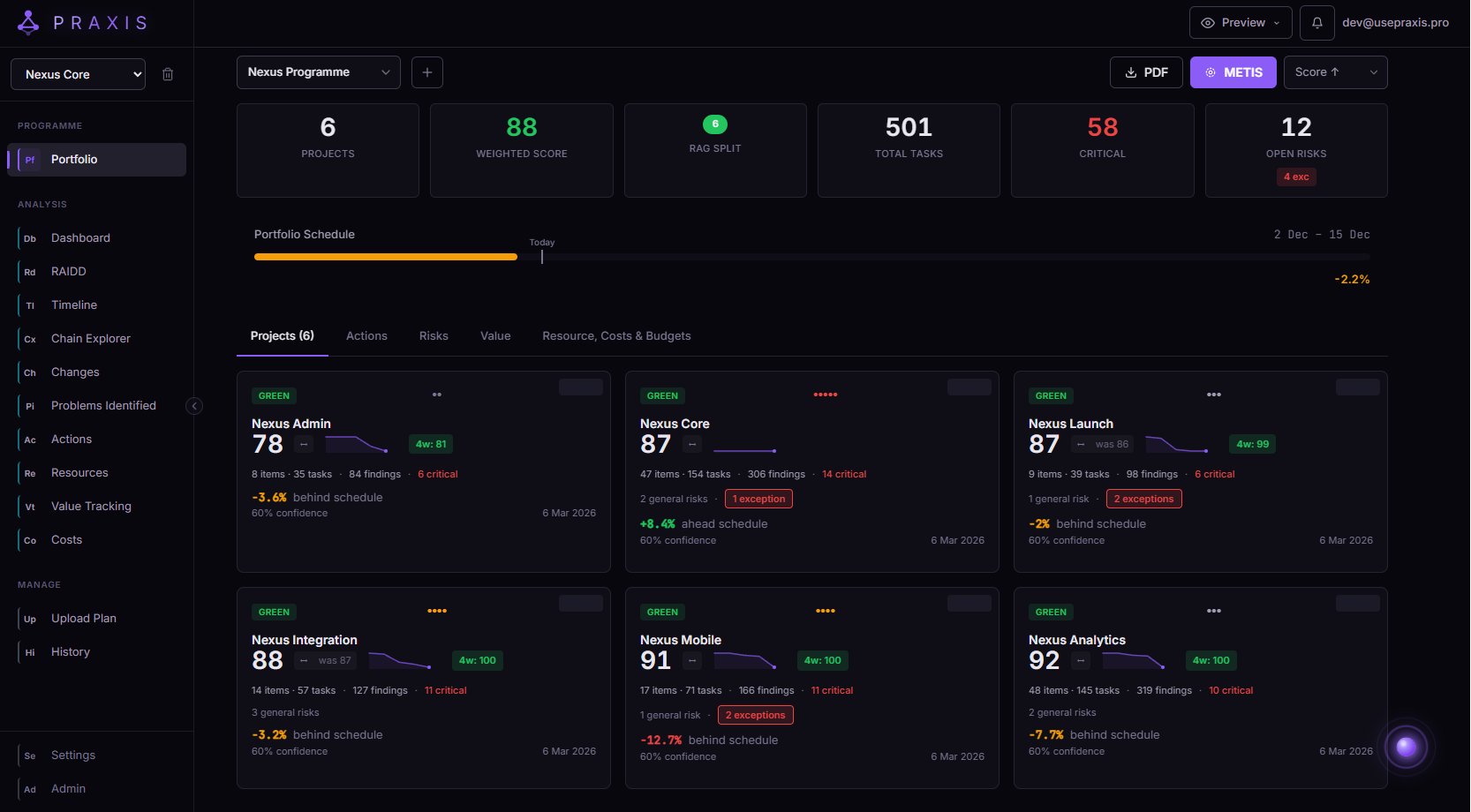
This is the programme manager's command centre. See health scores, trends, critical findings, and exception risks across every project in your portfolio. Find weak points. Spot efficiency gains. Track value delivery, budgets, forecasts, and resource contention — all from a single screen. No switching between tools. No chasing updates. The data updates in real-time as teams work.
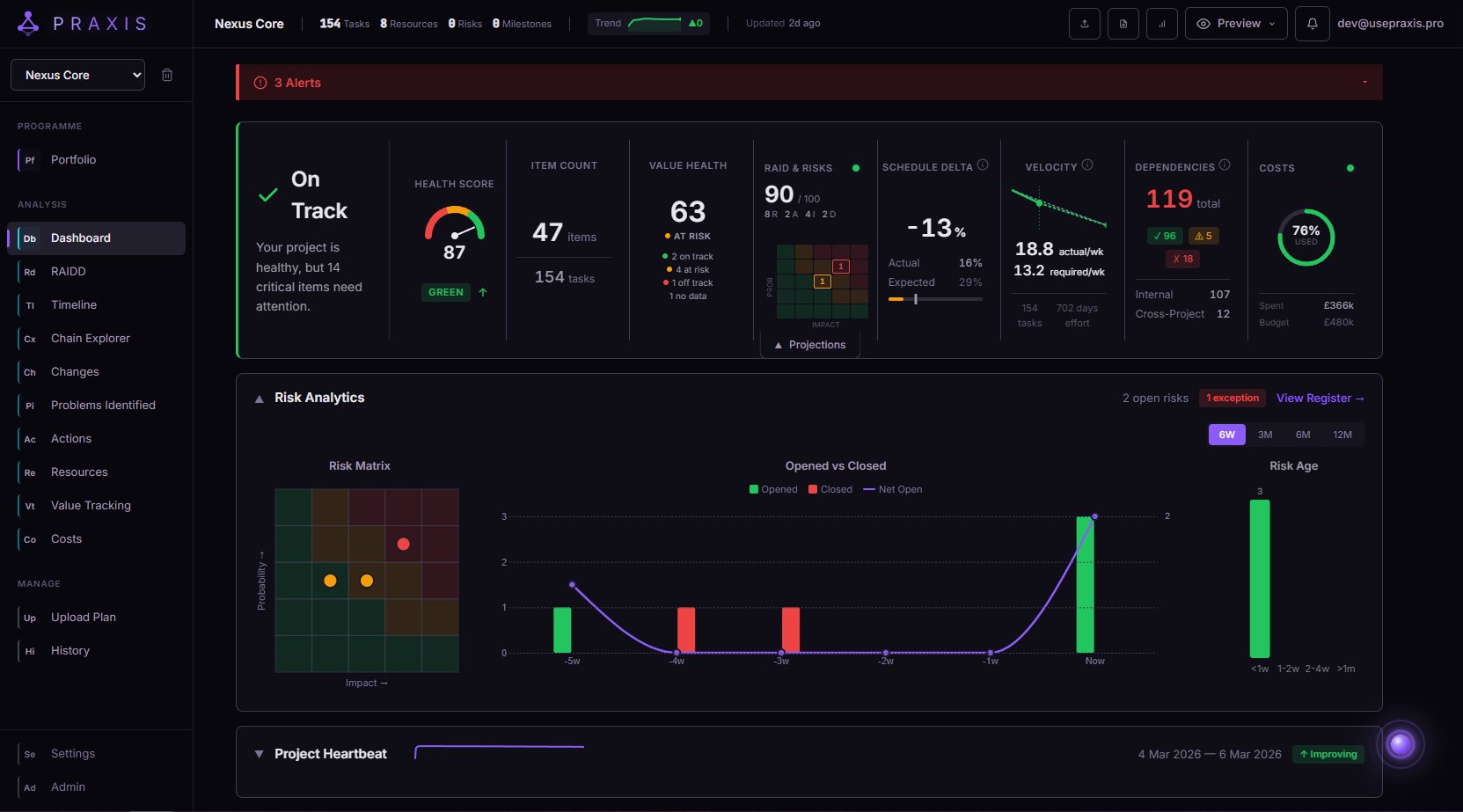
The project dashboard surfaces everything a project manager needs at a glance. Health score with RAG status. Item count and task breakdown. Value health showing benefits on-track, at-risk, and off-track. Schedule delta with actual vs expected progress. Velocity tracking showing whether you're delivering fast enough. Dependency count including cross-project links. Cost utilisation against budget. RAID summary with open risks and exception counts. Risk matrix with probability × impact heatmap. Risk age and opened-vs-closed trends. And the Project Heartbeat — a timeline showing how your health score has changed across every version upload.
This is what makes PRAXIS fundamentally different. The knowledge graph doesn't just store data — it connects it. A benefit has a cost. A risk has a financial exposure. A dependency slip has a budget impact. A resource over-allocation has a price tag.
Every query traverses multiple dimensions simultaneously. Ask “what if this person leaves?” and PRAXIS follows the chain: person → assigned tasks → critical path impact → effort share → downstream dependencies → cost exposure → value delivery at risk.
Raise a risk and score it as an exception — it immediately appears on the executive dashboard. If a risk's probability reaches 5, it's automatically escalated to the Issues log. If the system determines a risk requires a decision, it's added to the Decisions log automatically. Flag that decision for an executive's attention and it surfaces on their personalised dashboard for action. All dependencies between RAIDD items are automatically identified. If an assumption is approaching a tight date, a risk is automatically created. The whole system is interconnected and automated — while retaining full manual control to add, mitigate, update, and override.
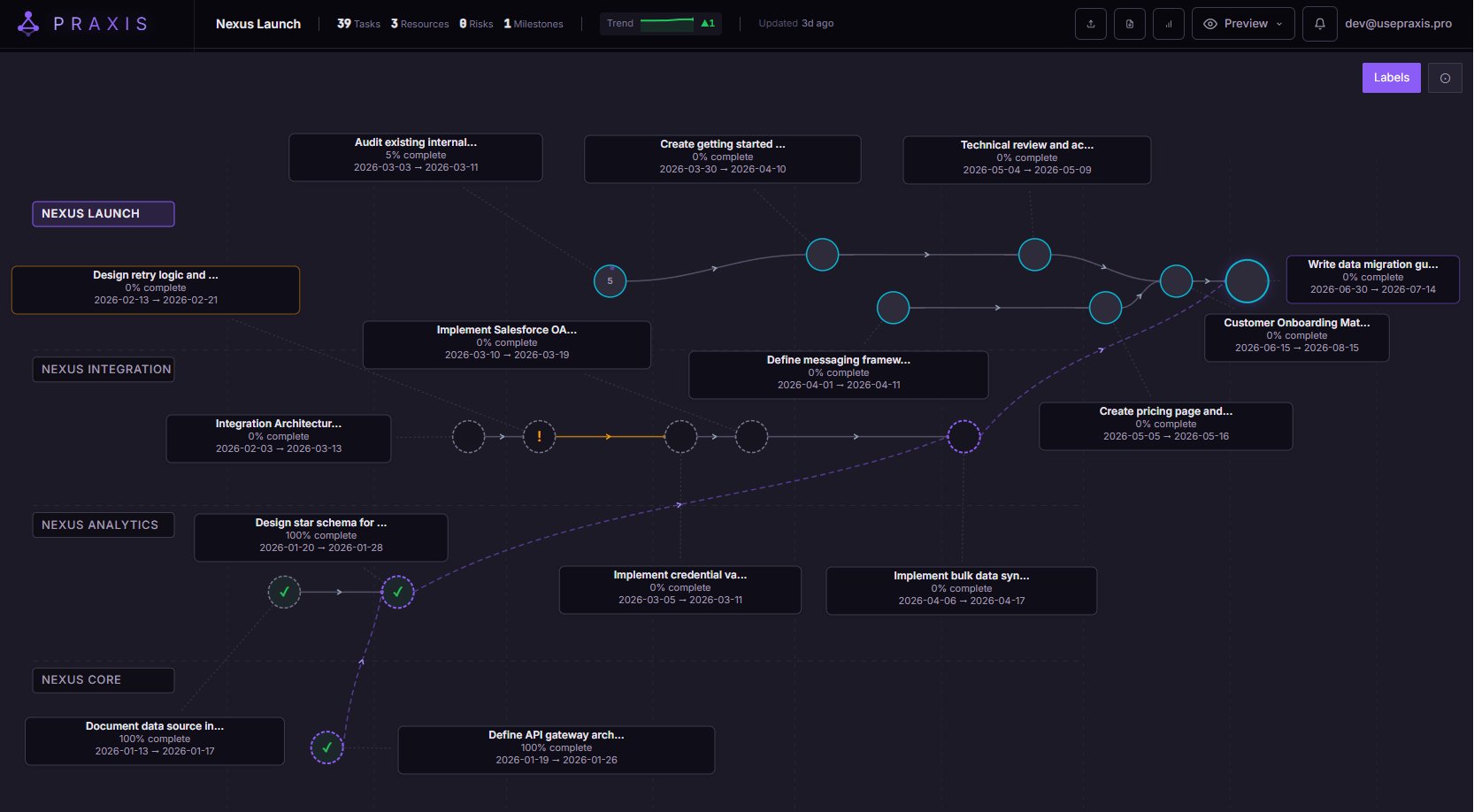
Multi-hop recursive traversal following dependency chains across project boundaries — up to 8 projects deep. Every node enriched with health findings, resource assignment, and critical path status.
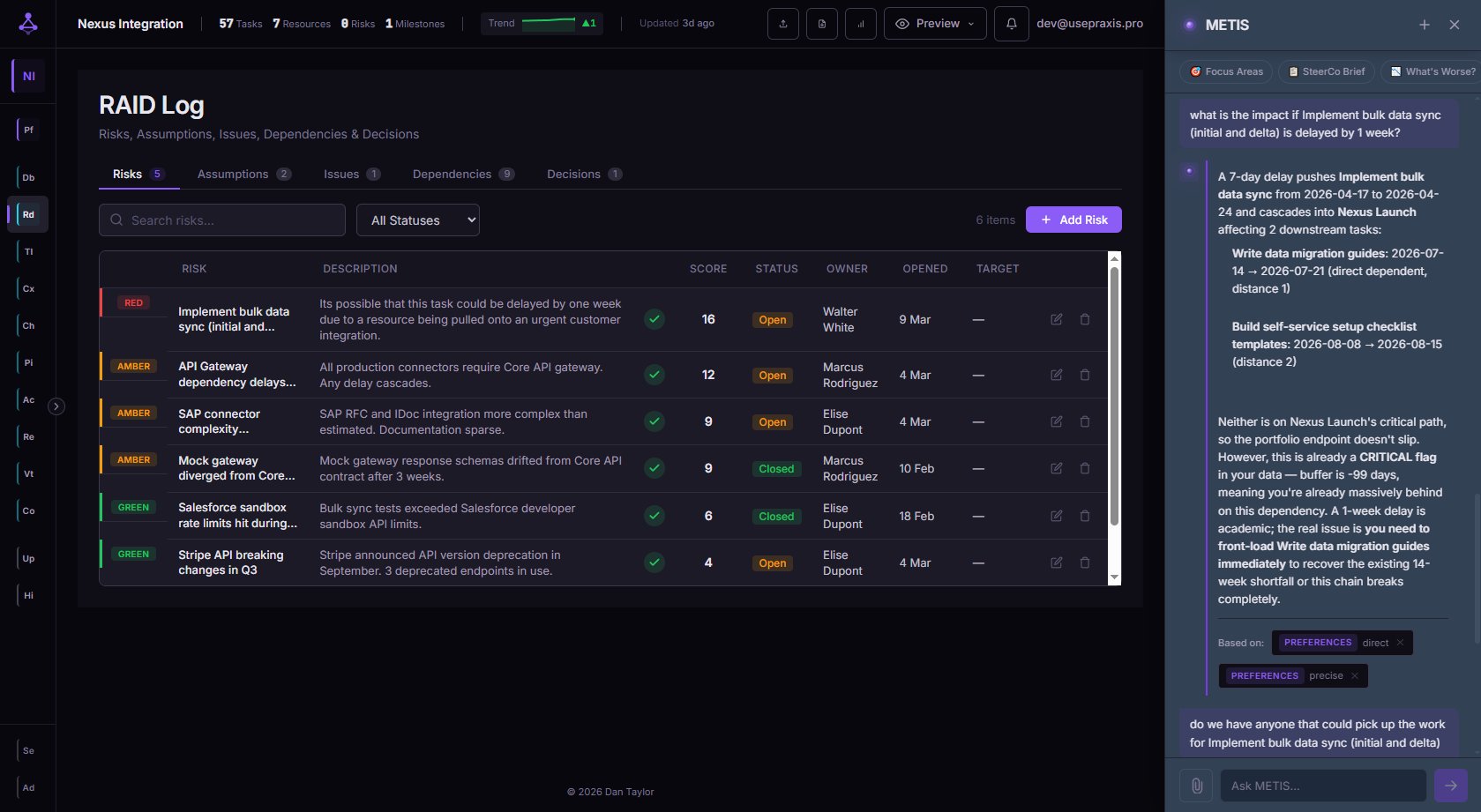
METIS isn't a chatbot with your data pasted in. It has 62 callable tools that execute real Cypher queries against the knowledge graph. It selects tools, chains multiple calls, synthesises results, and remembers context. From daily focus to SteerCo prep to what-if simulation — in plain English.
62 tools · 19 pre-built templates · Conversation memory per user and per project
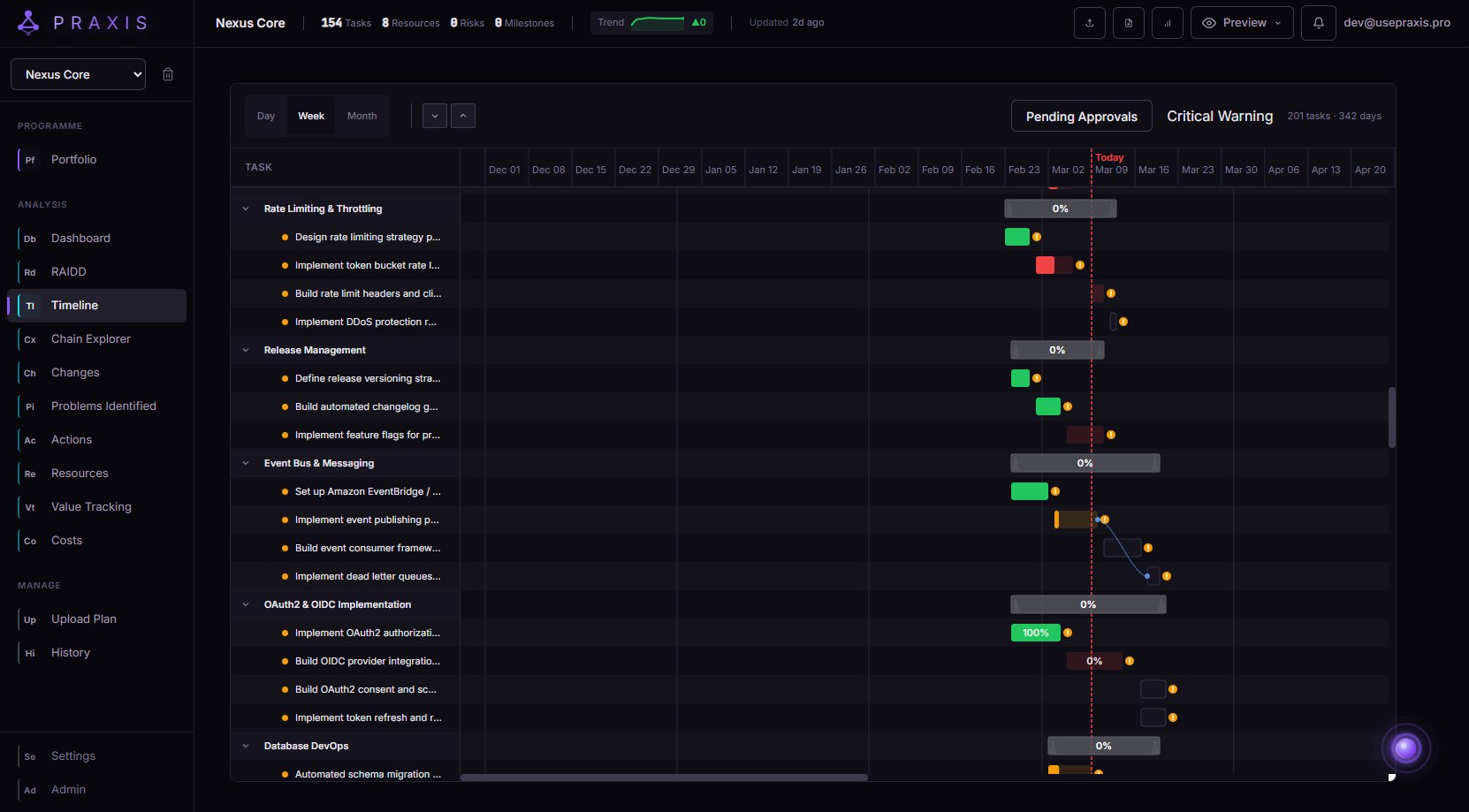
Full Gantt view with WBS hierarchy, dependency arrows between tasks, progress bars with RAG colouring, and a today-marker that instantly shows you what's behind. Collapsible summary tasks let you zoom from programme-level to individual work items. Day, week, and month views. Pending cross-project dependency approvals surface directly on the timeline.
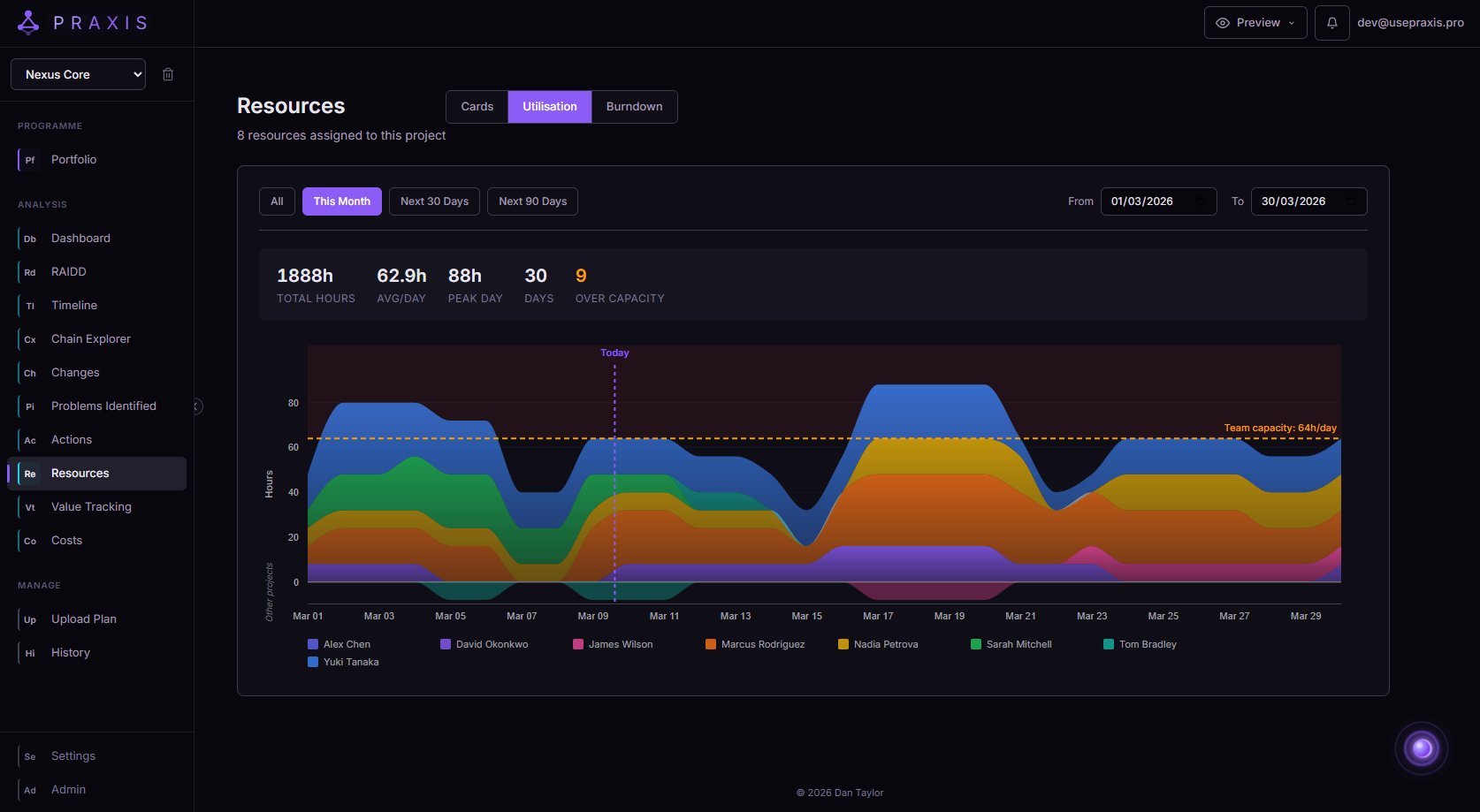
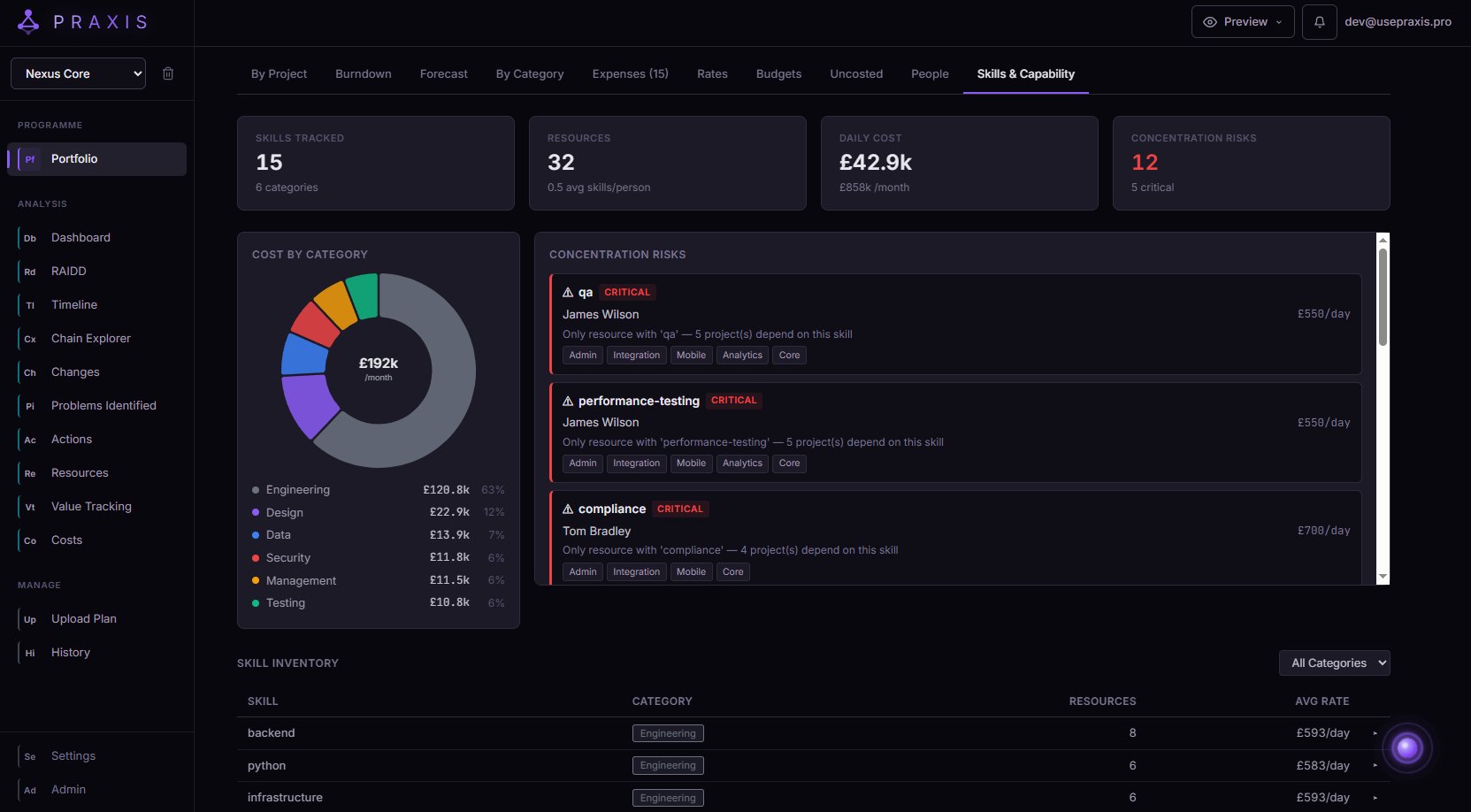
See where resources are over-allocated, under-utilised, or committed to other projects. The utilisation chart stacks every resource against the team capacity line — over-capacity zones are immediately visible. Resource cards show upcoming gaps with duration badges, total effort, and assigned tasks. At the portfolio level, see your full resource breakdown by skill set: 15 skills tracked, 32 resources, £42.9k daily cost. Concentration risk cards flag single points of failure — when one person is the only resource with a critical skill across 5 projects, you need to know. Understand immediately where there are gaps you can exploit, when resources are committed elsewhere, and whether velocity is hitting the mark.
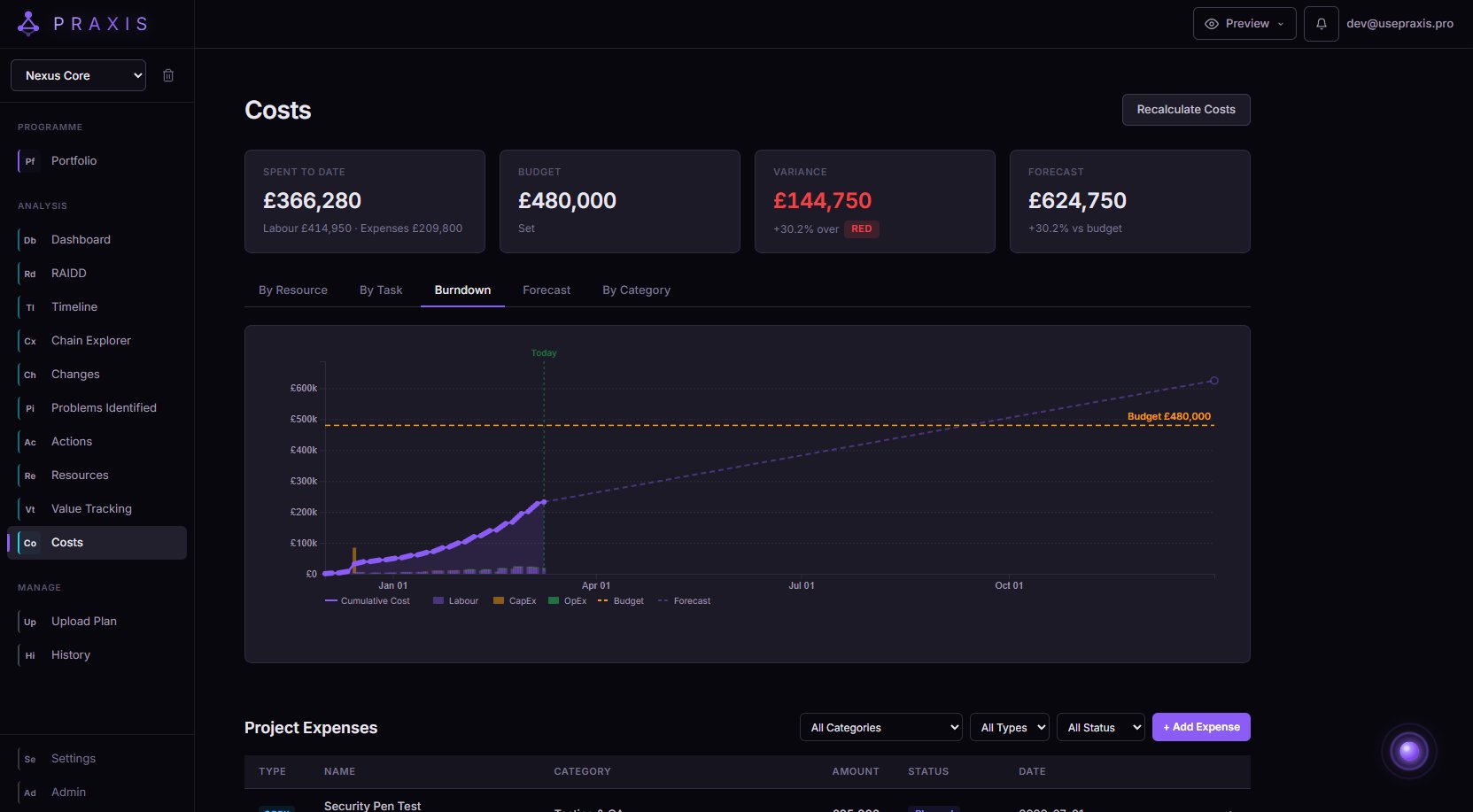
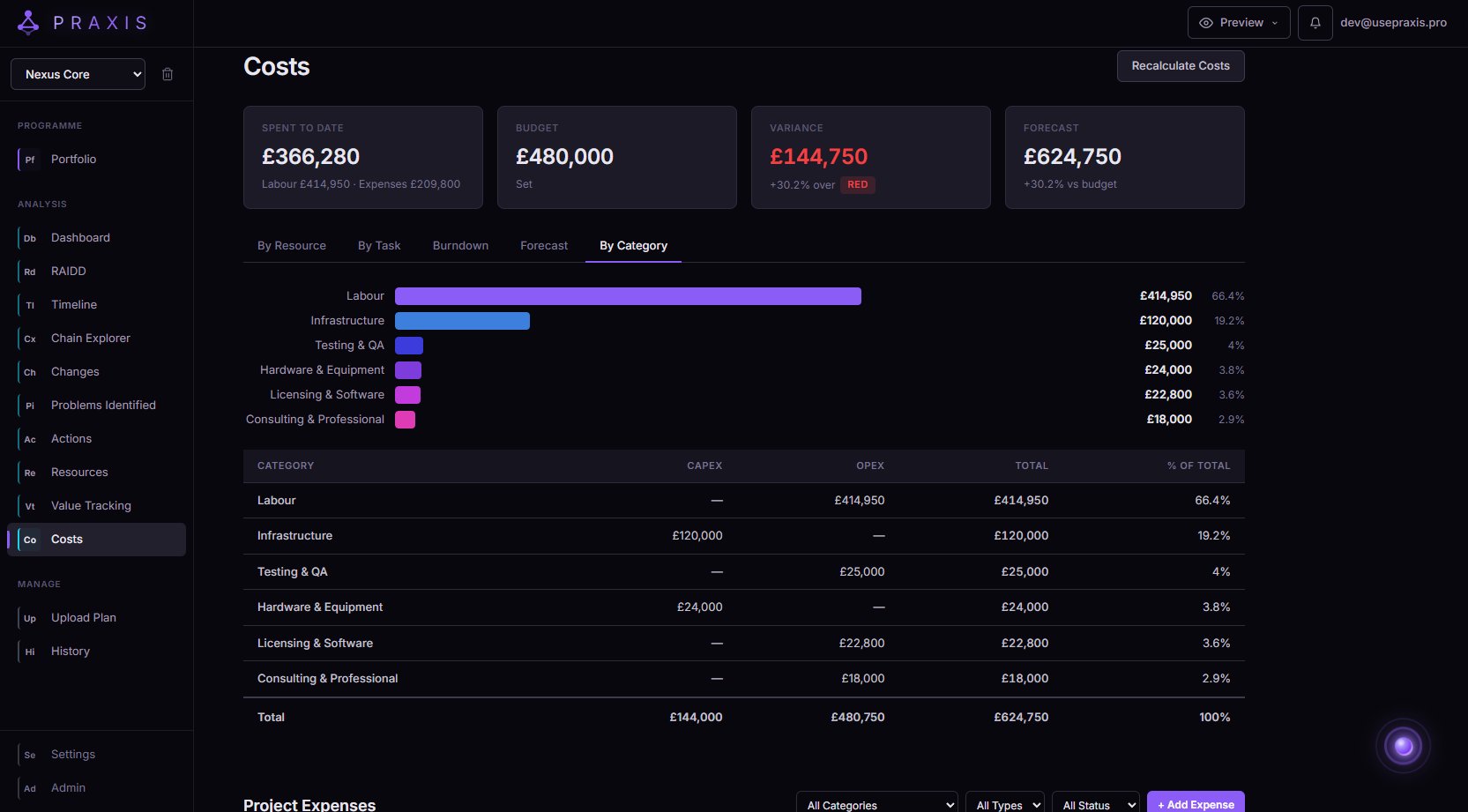
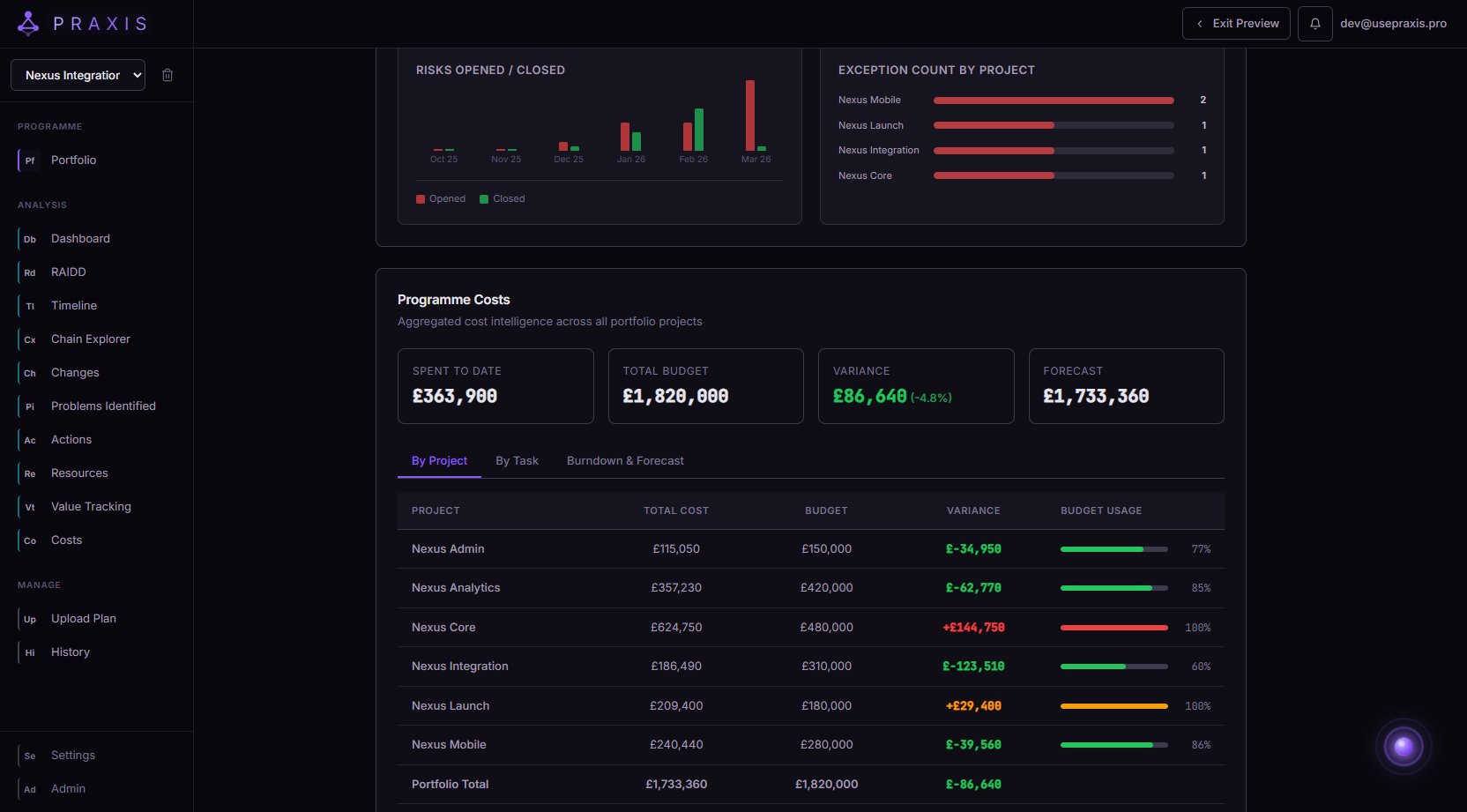
A DailyCost node for every resource on every task on every working day. Rate × allocation × working day. The burndown shows cumulative cost against budget with forecast projection. Category view breaks down Labour, Infrastructure, Testing, Hardware, Licensing, and Consulting — with full CapEx/OpEx split. At the portfolio level, see aggregated costs across all projects with per-project variance and budget usage indicators.
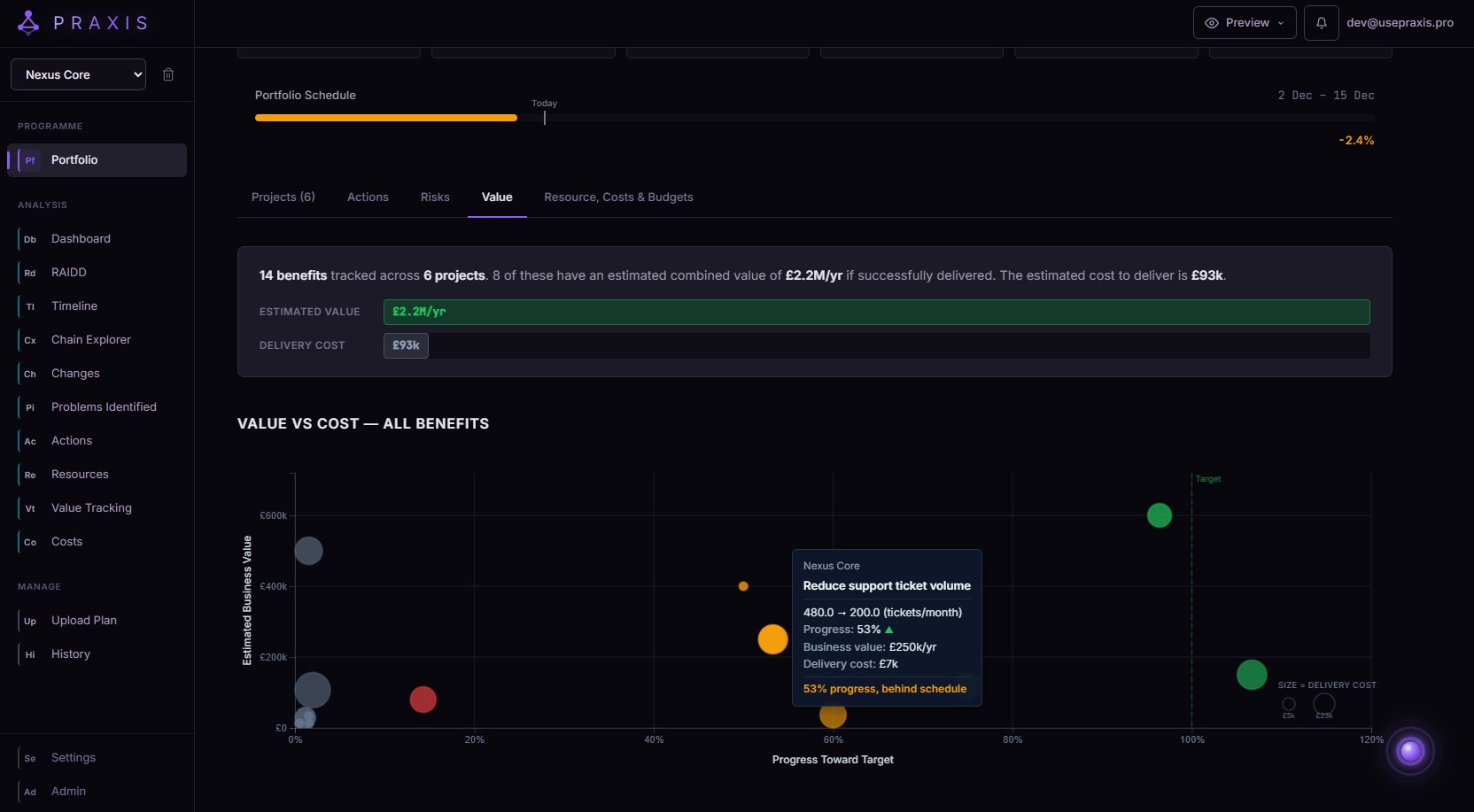
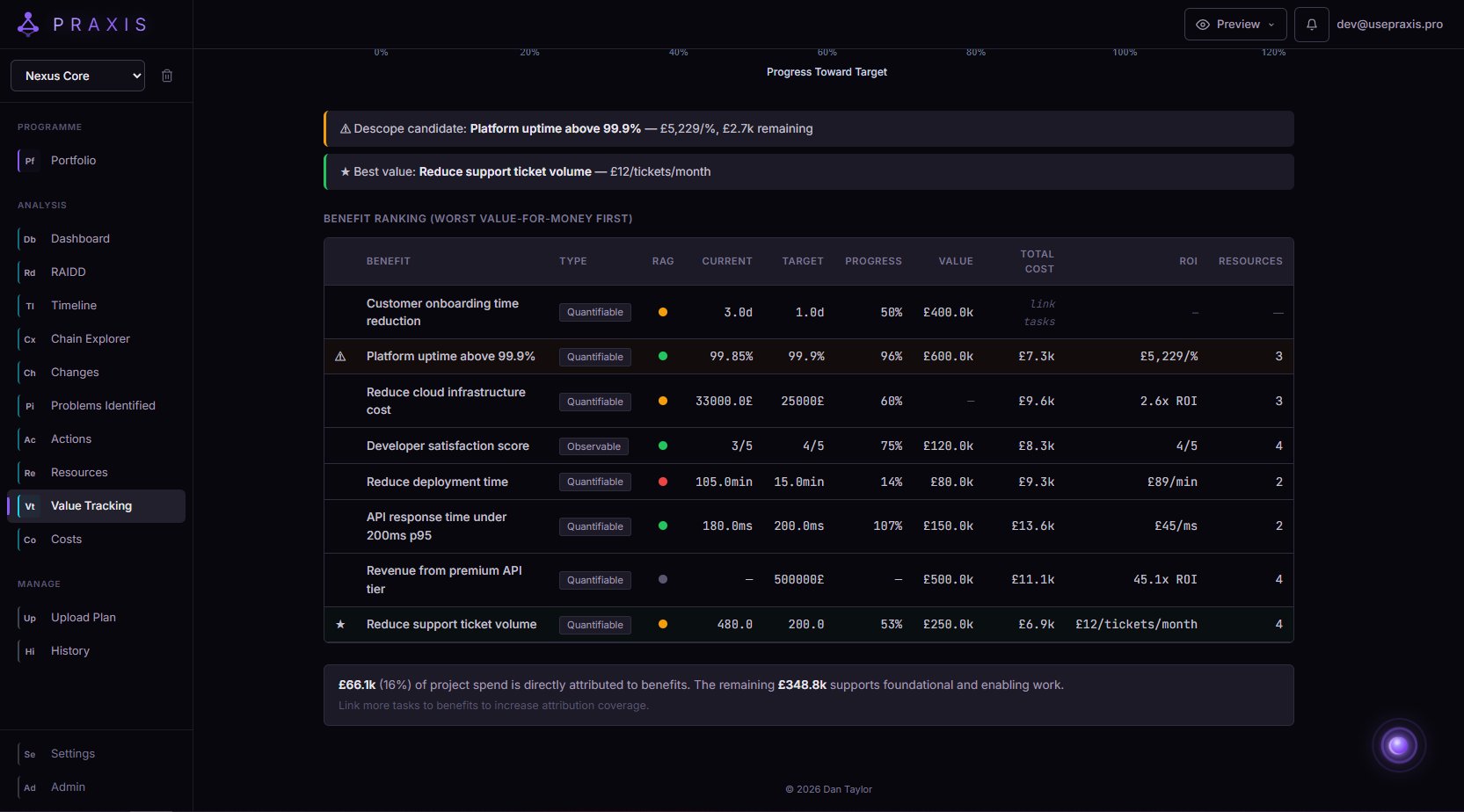
This is the question every programme leader should be asking — and as far as we know, no other tool gives you the ability to answer it like this. See immediately what each benefit costs to deliver, how much value it returns, and whether it's on track. 14 benefits tracked across 6 projects with £2.2M/yr estimated value and just £93k delivery cost. The bubble chart plots each benefit by progress, value, and cost. The ranking table sorts worst value-for-money first — instantly surfacing descope candidates and highlighting the best returns. Are we still aligned with the mission? Are we still delivering the right thing? This page answers both.
Four distinct dashboards for four roles, all updating in real-time. No more chasing updates about an item's status. No more asking how that risk mitigation is going. No more manually compiling cost reports. It's all there — for the right people at the right level of detail. Shareholders see portfolio health and nothing else. Executives see risk registers, cost intelligence, and items flagged for their attention. Project managers see everything in their assigned projects. Programme leads see everything, everywhere.
Every week, programme leaders spend hours pulling data from spreadsheets, formatting slides, and manually writing status reports. PRAXIS generates branded PDF and PowerPoint reports with one click — health scores, findings, trends, cost summaries, risk overviews, METIS-generated narratives, and recommendations. Ready for executive review in seconds, not hours.
Project-level analysis reports include health snapshot, category breakdown, METIS summary, velocity, schedule delta, items in progress, completion projection, critical findings, positive findings, actions, benefits, and version-over-version delta. Portfolio reports include aggregate health, RAG distribution, projects requiring attention, risk overview, and AI-generated portfolio briefing.
Hard numbers from the production codebase. Every figure verified against the live system.
Each constraint is a Cypher query stored in the knowledge graph. Positive constraints reward good practice. Smell constraints detect suspicious data patterns.
Native OAuth2 — no CSV exports, no manual syncing. Every sync creates a new immutable version. All 102 constraints run identically on imported data.
PRAXIS is actively developed with a clear roadmap from deep integration through to enterprise intelligence and consultancy tooling.
PRAXIS was conceived, designed, and directed by Dan Taylor — a programme leader with over a decade of experience coordinating 2,000+ initiatives across an 8-product portfolio.
After years building methodology at scale, and having successfully completed a major programme of work, Dan had the time and context to encode that experience into software. PRAXIS isn't built from theory or market research — it's built from the specific pain points, governance gaps, and intelligence blindspots that programme leaders actually encounter.
The 102 methodology constraints aren't arbitrary checks. They're the questions a good programme leader asks when reviewing a plan. The connected intelligence chains aren't academic — they're the cross-cutting queries that take hours in spreadsheets and seconds in a graph. METIS isn't a chatbot — it's the analyst you wish you had on every engagement.
The platform demonstrates deep technical capability — 305 API endpoints, a full Neo4j knowledge graph, custom D3 visualisations, AI tool orchestration — paired with genuine domain expertise in programme management methodology, governance structures, and value delivery frameworks.
A programme leader who conceived, designed, and directed a 305-endpoint platform with 62 AI tools, a Neo4j knowledge graph, and 102 methodology constraints — combining deep technical capability with genuine domain expertise.
View Dan's Profile →PRAXIS is entering alpha testing with programme managers who want to stress-test it against real portfolios. Early feedback shapes the product. If you're tired of the intelligence gaps in your current PM tools, let's talk.
Join Alpha Testing →